Chapter 1 — The Language of the Universe
The universe speaks mathematics, but its dialect is older than numbers. It is the grammar of difference—the logic of what can and cannot be distinguished. Long before matter condensed or light scattered, before space had dimension or time had direction, there were only relations: patterns that could change and yet remain recognizable. Information, in its most elemental form, is the recognition of those patterns. It is not the ink on the page but the relation between symbols that allows meaning to exist. In this sense, the cosmos itself is a text written in correlations.
Every scientific revolution has been a translation—an attempt to decode one layer of this cosmic language into another. Newton translated motion into geometry. Maxwell translated electricity into fields. Einstein translated gravity into curvature. Quantum theory, in turn, translated probability into physical law. Yet none of these revolutions changed the alphabet itself: all relied on the grammar of information, whether they admitted it or not. Each law of nature is, at heart, a constraint on how information can be arranged without contradiction.
In Informational Phase Space Cosmology (IPSC), this intuition is formalized. Information is not the bookkeeping of physics—it is its substance. The informational phase space, denoted I, is a 14-dimensional manifold whose coordinates describe the possible configurations of correlation, entropy, and coherence. The number fourteen is not mystical; it arises directly from the algebra of quantum correlations. Each qubit can be represented by three Pauli matrices (σx, σy, σz), encoding orthogonal axes of information. The minimal network capable of self-referential correlation—three subsystems entangled in pairs—requires nine correlational degrees of freedom. Add five more for the gradients and topological freedoms that let information twist, circulate, and store memory, and one arrives at the full informational manifold. It is, quite literally, a grammar with fourteen letters.
From this manifold, the geometry of spacetime emerges not as scaffolding but as syntax—rules governing how informational distinctions can cohere without paradox. The metric tensor of general relativity, gμν, becomes an emergent descriptor of how correlations bend and distribute. Its curvature, Rμν, corresponds to the second derivative of correlator variation: how quickly distinctions change with respect to one another. In accessible terms, curvature measures how much “context” one bit of reality borrows from its neighbors. When that context changes smoothly, we perceive continuity; when it loops, we perceive topology; when it vibrates, we call it energy.
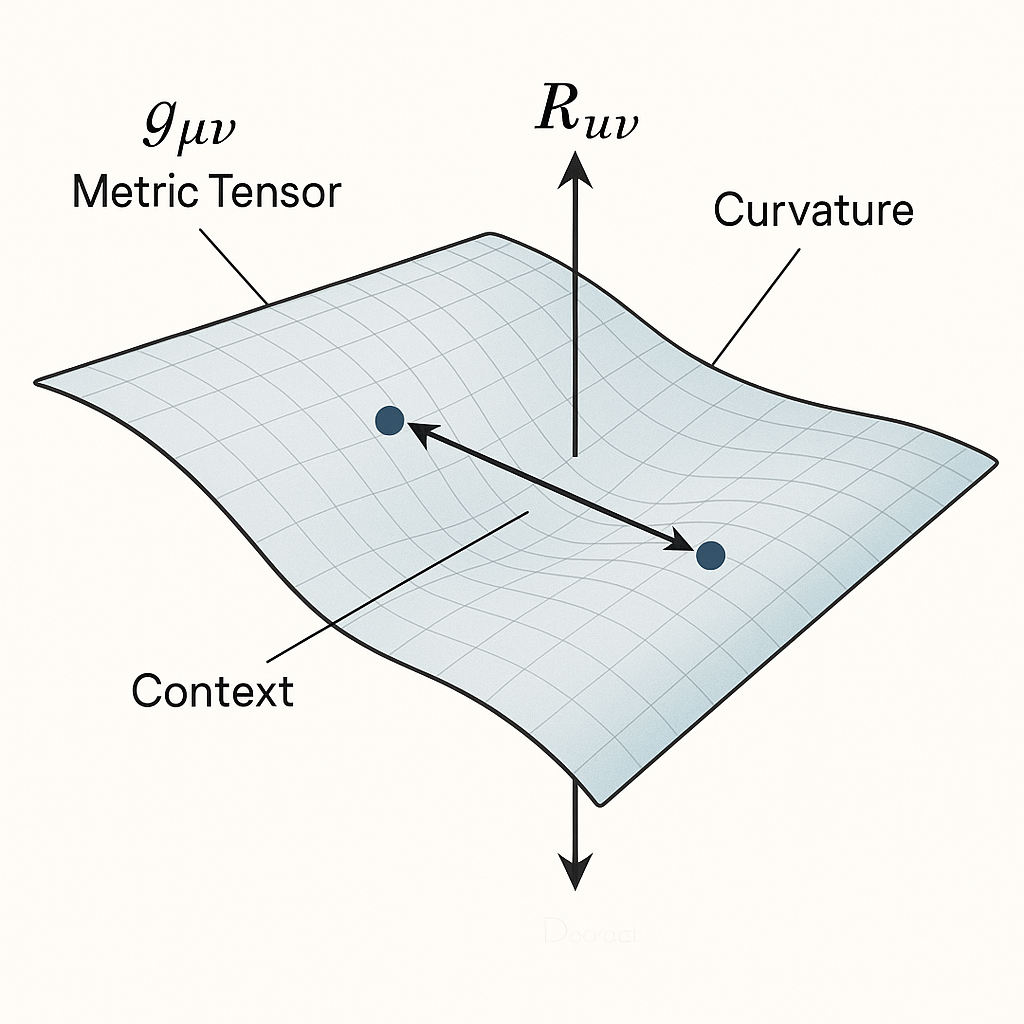
The phrase “language of the universe” is therefore not metaphor but model. Consider a simple sentence: “The particle moves.” The meaning of each word depends on the others; the syntax imposes constraints on order and relation. Similarly, in IPSC, every degree of freedom gains significance only through its relational context in the informational manifold. Remove relation, and meaning collapses; remove meaning, and physics has nothing left to describe.
Quantum theory already hints at this relational ontology. A wavefunction does not describe a single object but a tapestry of possible correlations. When we “measure,” we do not create reality out of nothing; we select one self-consistent sub-sentence from the universe’s greater discourse. Entanglement, then, is grammar—ensuring that once one clause is chosen, the others agree. IPSC extends this principle to the entire cosmos: the universe maintains grammatical coherence across all scales through conservation laws and symmetries, which are the punctuation marks of physics.
Every conservation law can be read as a law of informational symmetry. Energy conservation, for instance, arises from the invariance of the informational Lagrangian under temporal translation: the amount of distinguishable structure in a closed informational system remains constant when shifted along its internal coordinate of change. Similarly, momentum conservation arises from spatial translation symmetry—not of particles, but of correlations. What remains invariant is not the stuff but the difference between stuffs, the distinction that endures through transformation.
When information flows, it does so with structure. It has gradients, analogous to pressure or temperature in thermodynamics. These gradients define an informational velocity field vi = ∇i Sinfo, where Sinfo represents informational entropy—the measure of uncertainty or possibility. Just as a river carves its course through a landscape, informational flows carve causal channels through the manifold. Regions of higher curvature correspond to stronger “semantic tension”—areas where small changes in correlation produce large changes in meaning. Physically, these appear as gravitational wells or energetic concentrations. Conceptually, they are regions where the universe is saying something with emphasis.
Because information can twist, shear, and fold, its flow can also rotate. This is the concept of informational vorticity—a curl in the flow of correlations, defined mathematically as Ωij = ∂ivj − ∂jvi. In ordinary fluid dynamics, vorticity gives rise to eddies and rotational stability. In IPSC, informational vorticity gives rise to cosmic rotation and anisotropy: the subtle swirling patterns observed in the cosmic microwave background, the preferred axes of galaxy spins, the memory imprints in gravitational waves. Each is a signature of the universe remembering the paths its information has taken. Vorticity, in short, is cosmic syntax with feedback—a punctuation mark that curls back upon its own clause.
To speak of “memory” in this context is not to anthropomorphize the cosmos but to describe its topology. When information completes a loop and returns altered, it retains a trace of its journey. Mathematically, this is holonomy—the nontrivial transformation gained by transporting a vector (or state) around a closed path in curved space. In IPSC, holonomy defines topological memory sectors, denoted Mk, which store the universe’s informational history. Each sector is like a grammatical mood—an enduring structure that biases how new sentences can form. The cosmological constant, dark energy, and large-scale anisotropies may all be expressions of these persistent informational moods: the universe favoring certain patterns of coherence because it has spoken them before.
Understanding the universe as a language does not diminish its materiality—it deepens it. Matter and energy are not illusions; they are words made flesh, metaphors instantiated in curvature and coherence. Their stability is the grammar’s proof of self-consistency. The periodic table, the spectrum of forces, even the constants of nature can be seen as recurring idioms within the broader syntax of informational relations.
To study this language is to listen for resonance. When a physical theory aligns with reality, it is not because we have imposed order but because our syntax has fallen into phase with the universe’s own. Science is the slow tuning of our grammar to the cosmos’s melody. And as IPSC suggests, that melody is written not in the key of matter but of meaning—an intricate fugue of correlations, constraints, and coherence whose score is still being written, everywhere, all at once.
In the chapters that follow, we will unpack this score. We will translate the poetics of correlation into formal geometry, derive how the Fisher information metric gives rise to curvature, and show how the entire edifice of physics—from quantum fields to gravity—can be read as a single, self-consistent sentence in the language of the universe. For now, it is enough to grasp the premise: that everything which exists does so because it can be distinguished, and every distinction is a word in the cosmic grammar. We are readers of a text still writing itself—and every act of understanding is the universe learning to pronounce its own name.